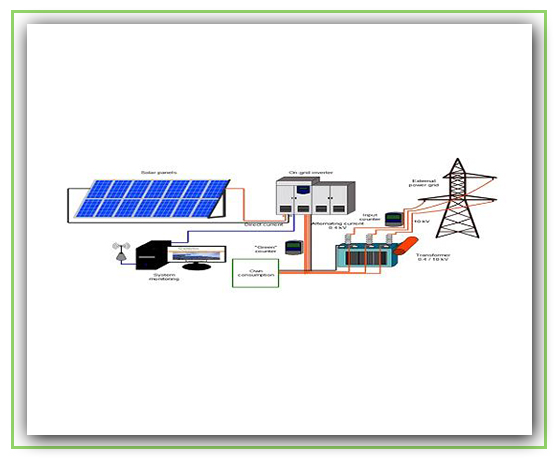
An on-grid solar system is designed to switch seamlessly between the residential solar system and the grid. It connects your home to both the utility grid and the solar system, so you can get electricity from either of the two sources.
Also known as the grid-tie solar system, this type requires only two main components: solar panels and solar inverters. Storage devices like solar batteries are not part of this system, therefore they cannot provide power backup.
In an on-grid solar system, the solar panel generates electricity and the solar inverter converts it into AC electricity. Thereafter, the electricity is used by your appliances.
If the system generates more electricity than your consumption, the excess electricity will be automatically injected into the utility grid. This system allows you to export unconsumed or extra electricity to the grid through net metering.
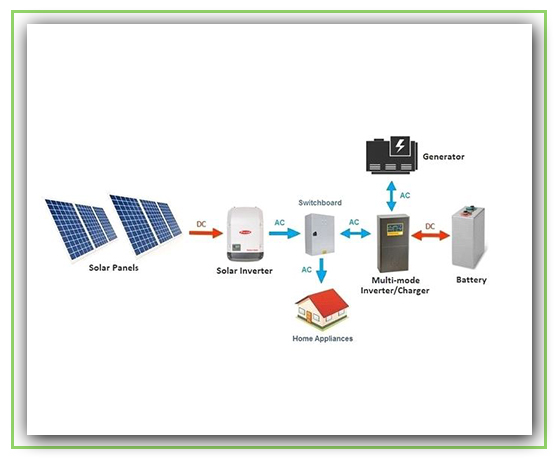
Specially designed for remote residences, an off-grid solar system is a complete power bank that is independent of the utility grid for functioning. This type of solar system is also known as a battery-based system and stand-alone system.
This system comes with a solar battery and provides power backup during emergencies or outages. Other functions and components remain the same as in the on-grid solar system. But instead of exporting extra or unconsumed electricity to the grid, it stores the electricity in solar batteries. This stored electricity can further be used to power your electrical or solar appliances.
The off-grid solar system is a battery-based, independent solar system that does not need a utility grid to illuminate your place. It is a complete solar setup with solar panels, solar battery, and solar inverter, and is ideal to lighten a home even in a far-off location. This solar system is more prominent as it comes with power backup.
Like every other solar system, an off-grid solar system uses solar panels to absorb sunlight and convert it into electricity. During the daytime, solar power runs the connected load and the balance energy is stored in the solar battery. At night, when there is no sunlight, the appliances draw energy from the battery to keep running. Hence, the system works day and night.
A battery based solar street light is a standalone system, which stores electricity generated by the solar panel in a solar battery. Solar LED street light is powered by a photo-voltaic panel, generally mounted on the light structure or integrated in the pole itself.
There is also another type of street light called integrated solar street light. In both types of street lights, the photo-voltaic panel charges the solar battery during day time, which powers the LED lamp during night. Street lights come with dusk to dawn sensors, which automatically switch on the light in the evening and switch it off in the morning.
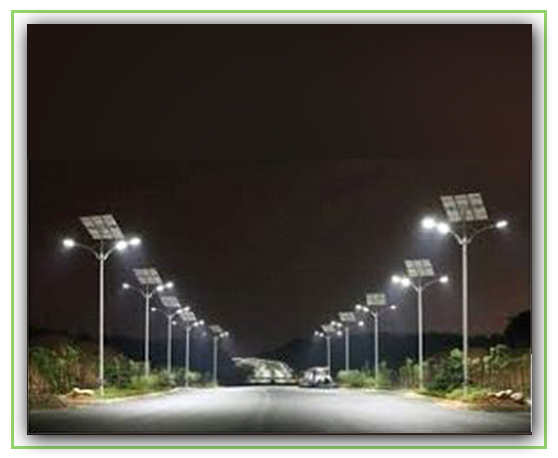
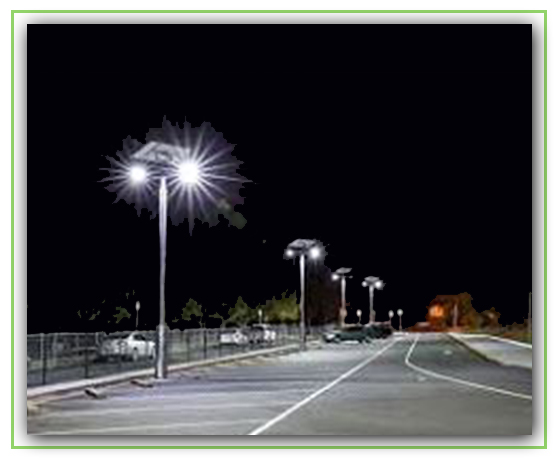
The effect of global warming was very recently felt in the earthquake and tsunami in Japan. As leaders in outdoor lighting, we are driven by the challenge of providing environment-friendly technology and focusing on a more sustainable renewable energy solution for our society.
Solar LED street lights address the situation in the best way. To begin with, LED lights use far less power than their old-fashioned counterparts and last for a considerably longer time, making them more economical and environment-friendly.
In addition, the quality of light produced by solar LED lights is far superior to conventional lights. Conventional lights mostly produce yellow-orange light, which does not allow high-definition visibility.
Employing LED technology, on the other hand, can create a much more powerful, crisper white light of far higher quality, significantly improving visibility and color rendition.
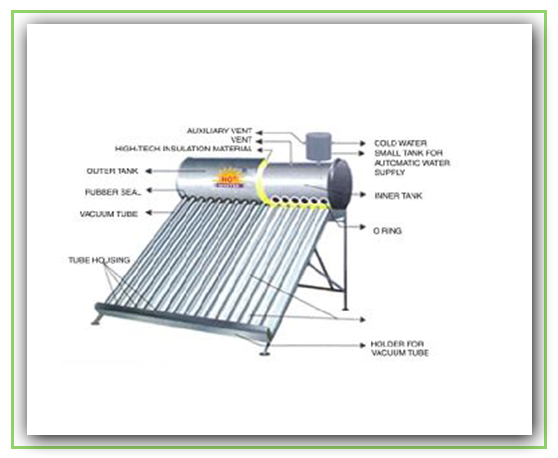
In ETC Solar Water Heater, the collector is designed to provide insulation using double layer borosilicate glass tubes. Each evacuated tube consists of two glass tubes having vacuum in between, which is an excellent insulator.
The outer wall of the inner tube is made to absorb maximum solar radiation. That is why the wall is coated with demanding absorbing material.
Evacuated Tube Collector (ETC) acts as an absorber in the solar water heater. The incident solar radiation falling on the tube passes through the outer transparent tube and strikes the outer wall of the inner tube.
It absorbs heat energy and then passes it to the cold water flowing in the tube. Hence, the heat gets transferred to the cold water, resulting in heating the water.
An evacuated tube technology based solar water heating system is most energy efficient and cost effective, and is best suitable for home use.
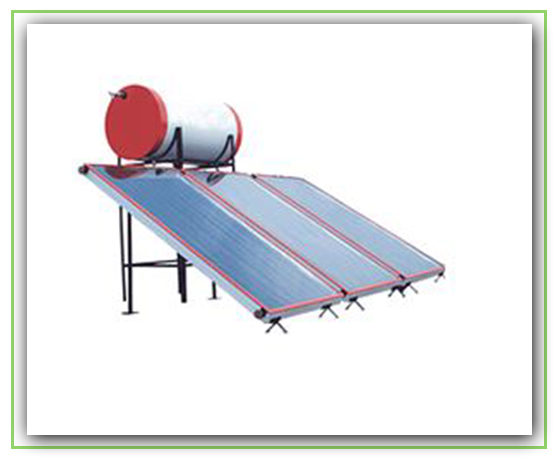
In an FPC solar water heater, the solar radiation is absorbed by Flat Plate Collectors (FPC), which consist of an insulated outer metallic box covered on the top with a glass sheet.
Inside, there are blackened metallic absorber sheets with built-in channels or riser tubes to carry water. The absorber absorbs the solar radiation and transfers the heat to the flowing water.
A flat plate technology based solar water heater is more energy efficient and has a long life. Hence, such a heater is most suitable for home use.
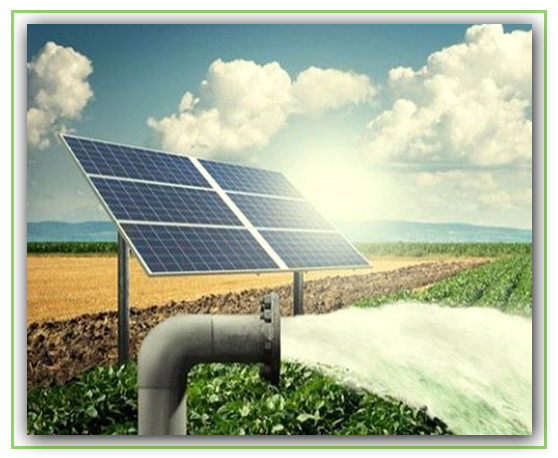
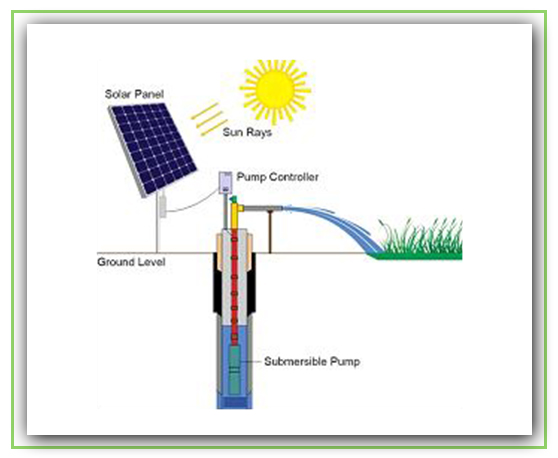
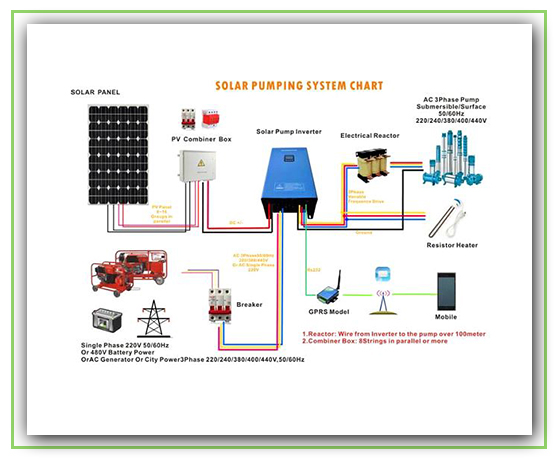
Solar submersible pumps are used where water has to be lifted from deeper underground. In simple words, this pump is used to lift water from a depth of more than 15 meters. To lift the water, simply put the pump inside the water and switch it on; the rest of the work will be done by solar power itself.
Solar submersible water pumps are the most preferable pumps in India, as the water depth is very high in maximum areas.
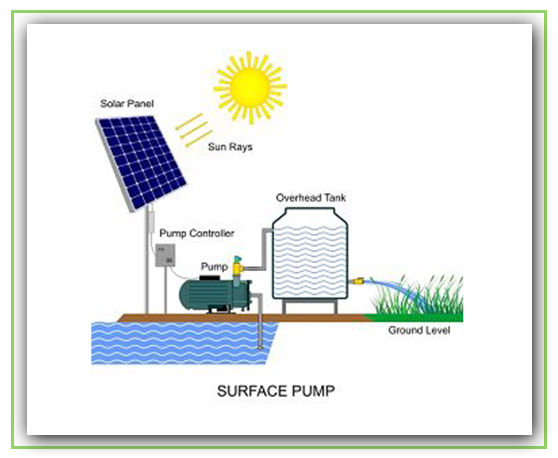
Surface pumps are relatively small but powerful water pumps. They are used to lift shallow water. If the depth of water is 15 meters or less, then a solar surface pump is recommended.
It can easily lift the water to the ground or above the ground level. You will find this type of pump pulling water from streams, storage tanks, shallow wells, and ponds at many places.
There are two technologies to power your solar surface water pump and solar submersible water pump: AC and DC technologies.
In an on-grid solar system, your water pump will be powered by a solar panel. If the solar panel generates more power than the water pump’s consumption, the excess power will automatically be exported to the grid through net metering. The government will adjust it in your next electricity bill.
In a hybrid solar pump, there are three power options to run the solar pump. The first is solar power, the second is grid electricity, and the third is a solar battery. During the daytime, your water pump is powered by solar electricity. At night, it is powered by the grid, and when both solar power and grid power are not available, it will be powered by the battery.